Thursday, 10 August 2017

Sunday, 30 July 2017
Tuesday, 28 March 2017
Truth and Taste
The entire court of the kingdom had gathered for supper. in the Great Hall His Highness, the king himself sat upon his seat at the end of the table, watching as his servants filled the table with one delicious course after the next.
Once the feast was prepared, the court remained with their hands on their knees, awaiting their king to declare the feast started, as noone may dine before his highness. The king grabbed his goblet and brought it to his lips, but before he could take his first sip of wine,
the doors to the hall burst open as if by a strong wind.
"Stop!", the eyes of the court was now focused on the king's spymaster, his shadows dancing by the candles of the chandalier. "Sire, put down that goblet! The wine is poisoned!"
The commotion that followed quickly spread across the Great hall and through the entire palace! The murmur of whispers were drowned out by the guards yelling orders at each other. The king himself gathered with his spymaster to see the master of the cellar. It was worse than he thought.
Out of the one hundred barrels of wine they had received that morning, all had been contaminated with deadly poison!
But it wasn't the ordinary, run of the mill poison that were stored in the barrels, but one of two magical potions. It was either that of Truthium, that when consumed has no immediate effect, but if and only if the next thing the consumer says is a false statement, he or she will immediately fall dead!
The other poison is called Falsium, that when consumed has no immediate effect, but if and only if the next thing the consumer says is a true statement, he or she will immediately fall dead!
Clearly they are dealing with a cunning and subtle assassin.
What a disaster!, the king laments. That shipment was supposed to last for the entire month, but according to the spymaster not a single barrel was free of poison. That the entire court would go sober for the entire month was unthinkable!
Then it occurred to him: what if they simply drank of the wine with the Truthium, and then have the court say something evidently true, such as "our king is a noble and merciful king"! Or from the falsium, and say something they know to be false. The poison, then would be powerless!
Alas, that were not to be, for the spymaster could not tell which barrel contained which poison, or how many of which poison was used. All he knew was that all barrels contained one of the two poisons, but for all he cared the barrels contained only truthium or only falsium.
The king, determined to see his solution realized, wrote a letter to the tasters' guild explaining the situation.
He gave the message to his messenger along with a skin of water and watched him gallop away! He would have his wine even if he had to sacrifice one hundred tasters!
Of course, it might not be necessary to sacrifice that many. It was a well-known fact the guildmaster of the tasters was an educated man proficient in the study of logic. Maybe he could figure out a way to determine what barrel contained which poison with only fifty tasters. Or ten!
After all, there are only ten times ten barrels in the shipment, so it would not surprize the king if it turned out to be a way to solve this problem with only ten tasters at most. And if there were, the guildmaster would undoubtedly figure it out!
And as night fell on the kingdom, the court were forced to drink water to their meal instead of wine. Early in the morning, the king was informed that the tasters that the guildmasters had sent was waiting outside the palace, so the king went out to greet them. As he entered the courtyard, his jaws dropped.
The guildmaster had not sent a hundred tasters, nor fifty, nor ten.
Two tasters were there! Only two!
How did the king manage to determine the content of all those one hundred barrels with only two tasters?
BONUS QUESTION 1: Is it possible to solve this problem with only one taster being sacrificed?
BONUS QUESTION 2: Is it possible to solve this problem with no sacrifices at all?
Tuesday, 12 April 2016
Solutions!
I've decided to reveal the answers to my puzzles. I've always felt that by revealing the answer you deprive something from the readers, even if you are only presenting the option of readin the solution. But lately I've come to realize that this is not a reasonable way to go about it.
First of all, I have to prove that there is in fact a solution. Maybe you should take my word for it. Maybe you should just assume I'm trolling you. Or maybe, and this might be the most likely of all, I have made a mistake or expressed myself poorly, and you should be given an opportunity to make your objections.
Second of all, I have to present the option of checking if the answer you have come up with is correct. I try to make it so that you know what the correct answer is when you see it, but if you have taken the time to solve my puzzle you should be granted the satisfaction to know that you are right; and sometimes the answer you thought was so clear to you might not be as clever as it seemed. I'd hate to allow any such derailed conclusions run rampant in the world.
Finally, the solutions of my problems are in fact kind of neat, and even if it's important that you come up with it by yourself, I still want the people who visit my blog to see both the problem and the solution.
So I've added a page where my puzzles and their solutions can be accessed. As I write more solutions they will be added to this page; as will any new puzzles.
Wednesday, 20 January 2016
The Butcher's Balance Scale
Here is my variation on a classic logic puzzle:
A butcher uses a balance scale in order to measure if he gives the right amount of meat to the customers.
For this scale he has six weights, all of which weigh a whole number of grams, for which he can weigh against the meat a maximum of all weights added together. If the scale is balanced he knows the meat weighs the same as the sum of all weights.
Furthermore, if he combines the weights in the right way he can weigh against meat weighing any whole number of grams under the sum of all weights and have the scale balance.
For example, if all the weights combined weighs 17 grams he can still use one or more weights to weigh 1 gram or 2 grams or 3 grams or 4 grams etc. all the way up to 17 grams, but not any more than 17 grams.
Knowing this, what is the most he could possibly weigh with these weights?
Monday, 2 November 2015
New number-puzzle!
I really should update more often...
Oh well!
23, 9, 10, 15, 9, ??, 29, 10, 31, 10, 14
Oh well!
23, 9, 10, 15, 9, ??, 29, 10, 31, 10, 14
Thursday, 5 February 2015
Another puzzle!
Did you miss me?
Of course you did! How else will you get on with your brain-teasers?
And brain-teasers I've got. I am currently in the process of making another Knights and Knaves style puzzle ( i.e. Wedding Whoopsies ) but there's a lot to keep track on when you do it. Until then here is a small number sequence for you to complete:
15, 175, 671, 1695, 3439, ??
For your information, I don't actually know if this puzzle can be solved. I know a solution that would satisfy the problem, but as far as I know there isn't a way to arrive at the correct solution, or the puzzle might be too ambiguous.
If I were to die, this puzzle would remain unsolved if it turns out to be too difficult for anyone on this planet.
But that probably won't turn out to be the case...
Tuesday, 27 January 2015
WEDDING WHOOPSIES SOLVED!!!
Have you solved Wedding Whoopsies yet?
In fact someone already has! Several people actually. I wonder if my puzzle was in fact too easy, though I did have to make those hints to help out.
In all fairness, however, those hints probably were of extremely little assistance, but I am so relieved it's possible for at least some people to come to a sound solution.
More coming up shortly!
Friday, 16 January 2015
Clues for Wedding Whoopsies!
1. In order to find out who ordered what, you first need to figure out who is lying and who is telling the truth.
2. Whether someone is telling the truth or lying depends on two things; what he/she ordered and what the neighbours ordered.
Since everyone is a neighbour of two people, as you change your theory on what any one person ordered you also need to change your assumption of not only the truth-value of that person, but also the truth-value of his/her neighbours.
3. Let's assume that two guests sitting next to each other both ordered A, which we don't know is Fish or Meat. Regardless of which is the case, all A are the same for all guests who ordered that.
Each of these guests has one more neighbour, both whom ordered B, which we also don't know is Fish or Meat, and may or may not be the same thing as A. All we know is that everyone who ordered B has the same thing, just as everyone who ordered A has the same thing.
From this we can't know if any of the guests are lying or telling the truth, but two of the guests are in fact sitting next to someone who ordered A and another who ordered B, which means that they have the same truth-value; if one of them is lying, the other one is lying too! And if one of them is a truth-teller, the other one is also a truth-teller!
But I am not saying this is definitely the case. It's just something that might be worth thinking about.
Sunday, 14 December 2014
Wedding Whoopsies!
Disaster occured!
Christine the waitress was hired to wait tables at a wedding where the guests had their pick between fish or meat, but all the invitations for Table-13 had been misplaced! Not one person in the kitchen had any idea how many of what dish had been ordered, much less who had ordered what! Panic spread across the kitchen as dinner-time enroached, but Christine was, in fact, not completely clueless!
For instance, she knew all of the guests were either zealously Christian, refusing to speak a single word unless they knew for certain what they said was unambigiously the truth; or patheological liars, so addicted to deceit they were unable to say anything unless they knew for sure it was the untruth.
She also managed to remember that all zealously Christian guests had ordered the meat only if the two people sitting next to them had ordered the same thing as each other, and had ordered the fish only if the person on their right had ordered a different course from the person on their left. By remarkable coincidence the patheological liars displayed completely opposite behaviours!
Christine drew a map of how the guests at Table-13 were placed:
 After interviewing the guests briefly she managed to come up with some info that might prove useful:
Christine the waitress was hired to wait tables at a wedding where the guests had their pick between fish or meat, but all the invitations for Table-13 had been misplaced! Not one person in the kitchen had any idea how many of what dish had been ordered, much less who had ordered what! Panic spread across the kitchen as dinner-time enroached, but Christine was, in fact, not completely clueless!
For instance, she knew all of the guests were either zealously Christian, refusing to speak a single word unless they knew for certain what they said was unambigiously the truth; or patheological liars, so addicted to deceit they were unable to say anything unless they knew for sure it was the untruth.
She also managed to remember that all zealously Christian guests had ordered the meat only if the two people sitting next to them had ordered the same thing as each other, and had ordered the fish only if the person on their right had ordered a different course from the person on their left. By remarkable coincidence the patheological liars displayed completely opposite behaviours!
Christine drew a map of how the guests at Table-13 were placed:
- BILLY: Everyone in this table ordered the fish.
- ELLEN: I most certaintly did not order whatever Billy is having!
- ANNA: Half the people here ordered the fish, the other half ordered meat.
- DANIEL: Don't believe a word Ellen says. She is definitely lying!
- FLORA: It's funny how all the people who ordered the meat are sitting together in a row!
Wednesday, 26 November 2014
Book burning!
This is not a fun post. Okay, maybe it will be. I can't help being funny, but this is a post about something I care about, and which I hope you care about as well.
The destruction of books is something barbaric. Books are our culture. Those who came before us live through their written words, and they contain part of our history; the reason we live the way we live now.
Nothing can replace that, ever.
No, not even burning Twilight is okay!
To destroy a book is the equivalent of murder, and I can't see how the opposite can be true. If someone disagree, please, explain to me. I would really like to know how you can burn yours or someone else's legacy then sleep comfortably that night.
Even if you don't think exactly that, very few would say that books ought to be destroyed. Yet that is exactly what is happening. Right now.
NOW!
I am not just talking about the normal wear and tear problem of simply failing to preserve the literature. At the moment of reading, people around the world, in your very hometown, engage in a concious and organized effort to destroy hundreds of books, and yes, it is probably by means of burning.
They are not bad people, mind you. See, books spends most of their natural life in something called "the market". Be it the library, the bookstore, antique store or second-hand shop, they always seem to find a way to get back that price-tag or that stamp.
Make no mistake though. The market is harsh and unforgiving, and not many, be it people or books, can survive there.
I've seen this happen with my own eyes. In fact, I admit to have partaken in this.
I used to work an internship back at Myrorna, a Swedish chain store run by and for the Salvation army, and sell second-hand wares; anything from toys to art to furniture. And books.
The idea is simple: accept gifts from people, sell them really cheaply and give all profits to charity. A viable alternative to driving all the way to the dump, the givers get to feel like they contribute, people with low income gets somewhere to buy necessities and the truly needing gets a much needed penny. Seems very nice on paper, but unfortunately not everything on paper transfers as neatly into reality. "The market" and "charity" don't really combine, and these types of companies are made to do things that the world probably would be better off without.
Many of their wares cannot be sold, and needs to be replaced by new wares that might sell better. When books don't survive the market, they are given a viking funeral, by which I mean they are burned ( thrown into the burnable trash at least, but I assume that it's "burnable" because they are supposed to burn at one point ).
So yes, literal book burning happens. Not just to worn-out books, or books whose popularity well exceeds their quality, but really old books from the 19th century and, I swear, from the FUCKING RENAISSANCE!
I could not afford to protest. I too am at the mercy of a cruel market that doesn't tolerate rebellious attitudes. I do judge them, and myself, but merely complaining is not going to make a difference.
We need action.
We need money.
We need information.
But first and foremost, we need awareness.
So please, dear reader. Whoever you are, spread the word. Tell your parents. Your brother. Your sister. Your newspaper. Your paperboy. Your milkman. Your cat. Tell everyone you meet, and tell them to spread the message. We are at a pivotal point in history, where we once and for all need to consider if our legacy matters to us, if the written language matters to us and if ideas matter to us.
There are people who need books in the world. Prisons, schools, children of developing countries. There are people who need to get rid of books.
There must be a way for these people to meet with each other.
My dream is to buy unmarketable books from stores and libraries, stock them and give them away to the needy. And I would like to think it can be done.
For more information, please visit this CRACKED article, which was the first thing that popped up when I Googled "book destruction".
In my defense, it's kind of a hard subject to research.
Monday, 20 October 2014
Happy Birthday!
Another friend of mine have her birthday today!
Hooray for friends!
You won't see many of these posts. I have some friends and family that mean the world to me and some people I look up to, and I wish to commemorate all the laps around the sun that have elapsed since their separation with their mothers' anatomy; but their birthdays are all concentrated into a single short period of time!
So what did I decide to give her? Well, I am a big fan of "it's the thought that counts", because other than thinking there is not much that I can offer. With that in mind, I decided to give her what I believe she wants more than anything right now.
Are you ready?
Here it comes!
This person is one of the most lucid people I know, yet she is frequently exposed night in and night out with shit that noone of her intellect should need to deal with.
Insanity in my mind originates from peoples' inability to make sense of the world, and that in turn can be attributed to the common belief there are things that cannot be made sense out of. After all, once you accept there are things that cannot be made sense out of, and you fail to immediately make sense out of something in turn, it is natural to think that is impossible to make sense of. In that spirit, I shall tackle some notorious paradoxes and expose them to the world!
All in her name ( of course, I don't want to give away her name in this blog ).
Zeno's Paradox
I have a little trouble coming up with a sufficient rolution of this problem only because I never really understood wherein the problem lies, and thus what solution would satisfy it. Nevertheless it occurs to me that whenever the tortoise is ahead of Achilles, it will be because he hasn't surpassed the tortoise yet; he is not yet out of the temporal frame of reference wherein the tortoise is ahead, and that will never be subverted no matter how many fractions are added, because the fractions will always be too small to make a difference. Let me demonstrate this with a well known constant: e
In simple terms; e is the sum of the reciprocals of the factorials of all positive integers.
... that didn't turn out very simple, did it?
It's basically just an infinite addition of fractions, each fractions significantly lower than the last:
1 + ( 1/1 ) + ( 1/ ( 1*2 ) ) + ( 1/ ( 1*2*3 ) ) + ( 1/ ( 1*2*3*4 ) ).....
And so on. Essentially you add one more factor to the denominator every time, always divided into 1 and then added to the soup.
There is no limit to how many times you can add into this, and each addition comes closer to e. And yet, we know that e is not only less than 3, it's less than 2.7182818284590452353602877!
It's the same deal with this "paradox"; of course there are infinitely many infinitely fine instances where the tortoise is ahead; that's true for ALL moments! That doesn't mean that in all moments the tortoise is ahead.
Unless Achilles trips and cracks his skull, but as far as I am concerned that is not part of this paradox.
Proof the Easter Bunny Exists
This is what we in the logic business call "circular reasoning":
As soon as someone proposed the concept of an Existing Easter Bunny, they already accepted the existence of the Easter Bunny; so proving its existence after that is kind of moot.
The Easter Bunny herself have, of course no obligation to exist just because we say so!
Right Triangle Paradox

First, that adding a square-unit to an object doesn't change its size, and second that rearranging the components of an object doesn't change its shape. In order to debunk this paradox we need to disprove both.
First things first, does the object actually maintain its size?
 Why, look at that! Once the triangles overlap you'll see they are not as similar after all! That little beer-belly might not seem big, but I bet it just about corresponds to the area of one square!
But that drives us to the next paradox. If one trianle is bigger, you'd think the components would also be differently sized, but upon examining it I find that not to be the case. So is there a paradox after all?
Wait a minute! Triangles don't have bellies! And look:
 No matter how hard I try I cannot make a straight line match the hypotenuse!
That's no triangle! It's an imposter!
And look! It turns out it was Adam from that one episode of Catfish!
 Now it all makes sense!
In all seriousness, if it doesn't behave like a triangle it is in all likelihood not a triangle. The red and blue shapes were designed to be intercompatible while still appearing as parts of a triangle. If you were to try and do that with the real deals it probably wouldn't turn out that way. In short, it's an optic illusion.
What can I say?
Seeing is not believing. Imperical testing is.
And these are my three paradoxes; all of them resolved!
My friend! There might be moments out there when life seem to consist out of paradoxes. Everything moves too fast, and you feel as if you can't keep up. The paradoxes you face may be much more perplexing than the ones I faced today; but that just makes them more worth solving!
I believe that for all the lies, delusions and empty words circulating across the world, there is still truth and beauty; there is still sanity. And I hope you discover that some day!
Hooray for friends!
You won't see many of these posts. I have some friends and family that mean the world to me and some people I look up to, and I wish to commemorate all the laps around the sun that have elapsed since their separation with their mothers' anatomy; but their birthdays are all concentrated into a single short period of time!
So what did I decide to give her? Well, I am a big fan of "it's the thought that counts", because other than thinking there is not much that I can offer. With that in mind, I decided to give her what I believe she wants more than anything right now.
Are you ready?
Here it comes!
A SHORT RESPITE FROM ALL THE INSANITY IN THE WORLD!
This person is one of the most lucid people I know, yet she is frequently exposed night in and night out with shit that noone of her intellect should need to deal with.
Insanity in my mind originates from peoples' inability to make sense of the world, and that in turn can be attributed to the common belief there are things that cannot be made sense out of. After all, once you accept there are things that cannot be made sense out of, and you fail to immediately make sense out of something in turn, it is natural to think that is impossible to make sense of. In that spirit, I shall tackle some notorious paradoxes and expose them to the world!
All in her name ( of course, I don't want to give away her name in this blog ).
Zeno's Paradox
One day mighty Achilles decided to challenge the swiftest tortoise in the land to a race to the ocean and back! In his clemency, Achilles granted the tortoise a head-start of n seconds, so when Achilles started running, given the tortoise ran at a speed of m meters per second, he was already at a distance of m*n meters ahead! It took Achilles only p seconds to travel that distance, but on that time the tortoise had already run p*n meters! Achilles managed to overcome that distance even faster, but then the tortoise were already several nanometers away! At this rate, given that Achilles must first pass an infinite number of points before he can overtake the tortoise, how can he EVER hope to win the race?
I have a little trouble coming up with a sufficient rolution of this problem only because I never really understood wherein the problem lies, and thus what solution would satisfy it. Nevertheless it occurs to me that whenever the tortoise is ahead of Achilles, it will be because he hasn't surpassed the tortoise yet; he is not yet out of the temporal frame of reference wherein the tortoise is ahead, and that will never be subverted no matter how many fractions are added, because the fractions will always be too small to make a difference. Let me demonstrate this with a well known constant: e
In simple terms; e is the sum of the reciprocals of the factorials of all positive integers.
... that didn't turn out very simple, did it?
It's basically just an infinite addition of fractions, each fractions significantly lower than the last:
1 + ( 1/1 ) + ( 1/ ( 1*2 ) ) + ( 1/ ( 1*2*3 ) ) + ( 1/ ( 1*2*3*4 ) ).....
And so on. Essentially you add one more factor to the denominator every time, always divided into 1 and then added to the soup.
There is no limit to how many times you can add into this, and each addition comes closer to e. And yet, we know that e is not only less than 3, it's less than 2.7182818284590452353602877!
It's the same deal with this "paradox"; of course there are infinitely many infinitely fine instances where the tortoise is ahead; that's true for ALL moments! That doesn't mean that in all moments the tortoise is ahead.
Unless Achilles trips and cracks his skull, but as far as I am concerned that is not part of this paradox.
Proof the Easter Bunny Exists
The way I see it, the existence of the Easter Bunny is predicated by the existence of an Existing Easter Bunny. So if we can find an Existing Easter Bunny, then that means the Easter Bunny MUST exist. Flawless reasoning! But doesn't that make the non-existence of the Easter Bunny quite absurd? Because there are exactly two cases; either the Existing Easter Bunny exists or she doesn't exist. But an Existing Easter Bunny that doesn't exist is clearly a logical contradiction! Since there are two cases; that the Easter Bunny exists or she doesn't exist, and as we know the latter to be necessarily false, we can simply deduce that the Easter Bunny MUST exist!So tell me then; what is the difference between an Existing Easter Bunny and an Easter Bunny? That an Existing Easter Bunny exists? How do we know the Easter Bunny exists? We don't!
This is what we in the logic business call "circular reasoning":
If A then A
A
Therefore ASee, there are logical contradictions, meaning every possible conclusion is false, and then there is the exact opposite of that, a tautology, wherein all cases are necessarily true! A tautology is often considered worse than contradictions, because a contradiction at least, we now to be false. A tautology is worse than false, it is unknowable!
As soon as someone proposed the concept of an Existing Easter Bunny, they already accepted the existence of the Easter Bunny; so proving its existence after that is kind of moot.
The Easter Bunny herself have, of course no obligation to exist just because we say so!
Right Triangle Paradox
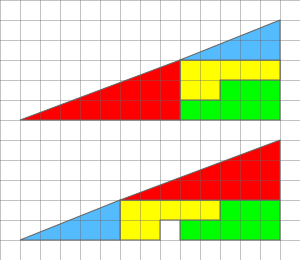
Compare these triangles. Which one is bigger? Have you discovered they are equally big yet? Well, yeah, they are equally big. But they shouldn't be! Because the lower piece is clearly missing a square! I mean, whoa! Squares disappearing? In perfect geometry? How is that possible!? It can't be possible, but clearly it is!The thing about this paradox is that it is actually two paradoxes in one hoax.
First, that adding a square-unit to an object doesn't change its size, and second that rearranging the components of an object doesn't change its shape. In order to debunk this paradox we need to disprove both.
First things first, does the object actually maintain its size?
But that drives us to the next paradox. If one trianle is bigger, you'd think the components would also be differently sized, but upon examining it I find that not to be the case. So is there a paradox after all?
Wait a minute! Triangles don't have bellies! And look:
That's no triangle! It's an imposter!
And look! It turns out it was Adam from that one episode of Catfish!

In all seriousness, if it doesn't behave like a triangle it is in all likelihood not a triangle. The red and blue shapes were designed to be intercompatible while still appearing as parts of a triangle. If you were to try and do that with the real deals it probably wouldn't turn out that way. In short, it's an optic illusion.
What can I say?
Seeing is not believing. Imperical testing is.
And these are my three paradoxes; all of them resolved!
My friend! There might be moments out there when life seem to consist out of paradoxes. Everything moves too fast, and you feel as if you can't keep up. The paradoxes you face may be much more perplexing than the ones I faced today; but that just makes them more worth solving!
I believe that for all the lies, delusions and empty words circulating across the world, there is still truth and beauty; there is still sanity. And I hope you discover that some day!
Congratulations!
Thursday, 16 October 2014
SOMEONE SOLVED MY BRAIN-TEASER!!!!!
I DID IT!!!
Well, she did it, but it's so fantastic to know that someone actually managed to take their time to solve my ridiculous puzzles! And thought it was worth it!
Or that's what I like to believe...
It was the birthday-child in question, of course! But she didn't post in the comments, so you just need to take my word for it.
To celebrate this momentous occasion I am going to post a good old brain-teaser:
10, 18, 24, 28, ??, 30
Have fun!
The Good News, and The Bad News ( feat. brain-teaser )
If you like brain-teasers, the bad news is there is only this one. The good news is that it's a tricky one. If you happen NOT to like brain-teasers, then there are only bad news...
999, 9999, 99000, 989001, 9890001, ???, 989010999
To those of you who happened upon a preview of this teaser, I added an extra instance to make it easier... or harder.
They are both good!
EDIT:
Did I screw up? Yes.
Am I sorry? Yes
Have I fixed it? Yes.
That's three yesses. I am glad we are staying positive at least!
Wednesday, 15 October 2014
On free will [part 2]
EDIT:
It ocurred to me that you might want to read the first part of the essay here!
You probably can understand this current post without it, but it assumes some things I justified in the previous part, so you should at least read both before posting.
You see, even though I very much like to base my beliefs and decisions on facts, I am not actually ready to give up "free will".
See, I like judging people. I draw joy from pointing out the flaws in their decision-making process; I thrive in criticize their information-gathering technique and I become absolutely ecstatic when I get to extend my less than flattering opinion on their abilitiy to assess a situation.
A lot of people don't care for this attitude. They'd rather I approach a self-afflicted atrocity with grievance, sympathy or even blame! To me though, the best reaction by far to apparently zealous commitment to stupidity is that of amusement! And yes, I do extend this principle to myself as well.
Of course I don't judge indiscriminately. A tiny infant, for example, is expected not to hold the same standard of judgement as that of an adult. Same goes if you have some sort of condition that cause you to have the equivalent analyzing-prowess of a lobotomized sea-horse. Same goes if you are under the influence of alcohol or other drugs that impair your judgement, though I can, and will, judge the decision of becoming inebriated to the point where you are liable to drown from pissing in your own mouth. However, this is not always the choice of this person. They might be forced to consume it, or tricked, or perhaps it's consumed it compulsively. Which brings me to my next point; if there is only one choice to make then that cannot be a poor choice. If someone is coerced, through threat or blackmail, into doing something they would otherwise never do, they can't be judged for doing that. That will only display ignorance on the part of the judge.
What I fear is that these constraints are not exclusive to the ones mentioned above. What if every poor decision is actually the only conceivable outcome of a linnearly progressing universe? What if everyone who made an evidently poor choice is actually the victim of chance?
This is true for the opposite as well. As you no doubt have learned from my Nansen-thread, I am very enthusiastic of the subject of men and women who not only excel at their field, but make significant contributions to many if not all enterprizes they pursue.
Do you mean to say that what Nansen achieved when he crossed the ice-caps of Greenland was not just not impossible, as it was thought to be at the time, but in fact inevitable? After all, what evidence is there that these people are in fact the architects of their own fates?
So that's the gist of it. What happens when one of the fundamental premises of which we understand the world and according to which we operate turns out to be false? Am I to be forced to accept the fact that both the people I admire, and the guy who put his hand in the tank full of lobsters with rabies, are my...equals?
Now I want you to participate in a small experiment here before we continue. It will literally only take a couple of seconds:
Look up.
Alright, there are now two possibilities; you either looked up and then returned to look forward into your monitor; continuing to read this text. Or you did not look up and continued reading the text regardless to see where I am going with this, in which case I am very, very disappointed!
Now, for those of you that looked up, let me make some educated guesses as to what you saw:
the ceiling, the sky, perhaps a tree you are sitting under. But how can I know these things are actually "up"? The word "up" doesn't actually have any inherent meaning. The "up" of me is the "down" of some guy in New Zealand. In the midst of space, which I will remind you most of everything is, where "up" is can vary from one second to the next as you rotate indiscriminately
Evidently "up" is not a concept we can rely on if we want to understand the universe, but does that mean everyone who looked "up" is some kind of moron? My vote is for "no", because if I could not input the instruction of "up" into a coworker, that would be one sub-par window-cleaner!
I think there is a similar deal with the concept of "free will". Because it happens to coincide with the way we experience our everyday life so accurately, abolishing it would result in an inconvenience. It's a concept we use to imagine and evaluate the decision-making process of rational agents. It's used to, amongst other things, reason with concepts such as responsibility, credit, consent and guilt; things that carry much weight in our current society.
That is my answer; one might say that the concept of free will is nothing but an invention of mankind, but that does not mean it doesn't exist. After all, lots of things invented by mankind do in fact exist. What about the coffee-makers? Paint-brushes? Those bells you put around the necks of cows? This doesn't even apply to things that have physical representations. What about language? Math? Laws? All of those "exist" in a meaningful way, even though they are inventions of man. What makes the concept of "free-will" any different?
Of course, the way we perceive our environment is not constant thorough the course of time. Perhaps some time in the future, when travel through the solar system has become a commodity, we will have to use an alternative to "up" and "down" to navigate ourselves. And perhaps at some point, when the actions of sane individuals, if not accurately predicted, then accurately traced and explained. At this point our understanding of human agency will mutate, and our language with it. It is obvious, at least to me, that this is a type of change we should embrace; but is that what will happen? If we do, will our entire judical system be seen as a pretentious and cruel way to manipulate behaviour by means of coercion? With these implications in mind, will a conflicting view of volition be met with resistance? As a defense for our own cruel imagination? If so, are we expected to come up with alternatives now?
I am a little uncertain how to end this type of posts. I would prefer to end it with a question, but that seems a little... unsatisfying. I hope I have managed to pique your interest at least, but honestly I am just as satisfied if I managed to bore the shit out of you. Or if I manged to instill boiling rage inside you. Essentially the only objectionable outcome is if you just sat there with a moronic smile, nodding like a complacent yes-man. But there is nothing much I can do about that, other than start writing about something more interesting.
Anyway, I hope you enjoyed my input on this subject. I will make more philosophical posts in the future, but not so often.
Have a nice evening/day/night etc.
Sunday, 12 October 2014
Mailbag time
Hello, world!
It's the time of the year, when Mars is in Sagitarius and I just need to read some reader-mails. Remember, these are some real mails I have actually gotten from real people. Here we go:
That is a very good question, Al, one I in fact know I am not qualified to answer. There are, however, some steps to follow that I personally find helpful:
1. Identify a problem. This one might be harder than it seems; most of the time people are unaware that they have a technical problem. Ocassionally it manifests as a crisis that is to be dealt with at the moment, or as a personal conflict. Think about it; thorough most of history man has been without the Internet, and nobody missed it. But one day someone had the insight to see; "Nobody shall need to go 50 minutes without watching a cat in a tux play the piano!" and thus the Internet was born. Could this just as well have happened during the French revolution? Or during Roman times? Of course it could, but nobody thought of it!
One way to accomplish this is to identify a necessity, a commodity or a convenience; go through the step-by-step process of how to acquire it and then figure out exactly what could go wrong at any one step.
Of course, that's the long, narrow way; many of the things that can be invented already have been invented. What you can do instead is to look at some of the current invention, and see what problems or inconveniences they cause. This doesn't actually make the old invention bad, it's just the natural way of progress. For example; food-poisoned by birthday candles!
If you still can't think of anything, just focus on some stock-problems as an exercise. Problems that are constantly being worked on, but never solved to satisfaction. Such as destroying your fellow man; perhaps the earliest and more prioritized problem in all of history.
2. Backwards induction. Inventing something is very much like putting a jigsaw puzzle together; every problem has a solution-shaped hole that is just waiting to be filled in. Try to imagine that you have already solved the problem. What would such a solution look like? What properties does it have? Then try and think back what step you would have taken in order to do that, and what step you would need to have done to do that. Eventually the path to your invention is clear.
For example: infants gets sick because the candles are made of wax, thus you need a candle the children won't get sick of even if they eat them. They don't, as a rule, get sick from marzipan, thus birthday candles made of marzipan are the solution!
It might be useful to review other inventions, see if their functions are applicable for what you are trying to accomplish. For example, flypaper can be used to trap flies. Can they also work on seagulls? Or baboons?
3. Figure out what's wrong with your invention. See, the reason people might not see a solution where you can might not be because they are too stupid. It might be because they are smart enough to realize the drawbacks of your device even before they even thought of it. For every ingenuity, there are tens of thousands of tiny adversaries that needs to be overcome, and at least one crisis. That's why it is important to critically review your ideas for any problems that might occur because of it. For example, I made a list of all the things that might prove fatal when designing my candles:
- Marzipan melts really, really fast
- Burned marzipan tastes like dank piss
- Warning: May encourage consuming the lit thread
And any one of these items might be the reason nobody else has thought of these types of candles before.
Don't be discouraged though! The more you know about your problem, the more you know about your finished product. Once you can't think of any more problems it's time for the worst part of the process:
4. Construction. See, this is the part which actually requires competence on your part. If you are anything like me and your digits are mostly there for show, then I suggest you ask someone else do this part.
5. Testing. Oh, you DEFINITELY don't want to be the one doing this one. Try and configure this step as some kind of innocent prank....
6. Marketing. Remember: you have not made a mouse-catcher before it is catching mice. You need to make the public aware of the problem, and the convenience of your invention. Try coming up with a catchcy slogan like this:
This has been your relatively arrest-free guide to making an invention. Please comment if you found my advice to be sound!
It's the time of the year, when Mars is in Sagitarius and I just need to read some reader-mails. Remember, these are some real mails I have actually gotten from real people. Here we go:
Dear Nick of All Trades!
What can you tell me about being a successful inventor?
Yours truly:
Nick of All Trades
That is a very good question, Al, one I in fact know I am not qualified to answer. There are, however, some steps to follow that I personally find helpful:
1. Identify a problem. This one might be harder than it seems; most of the time people are unaware that they have a technical problem. Ocassionally it manifests as a crisis that is to be dealt with at the moment, or as a personal conflict. Think about it; thorough most of history man has been without the Internet, and nobody missed it. But one day someone had the insight to see; "Nobody shall need to go 50 minutes without watching a cat in a tux play the piano!" and thus the Internet was born. Could this just as well have happened during the French revolution? Or during Roman times? Of course it could, but nobody thought of it!
One way to accomplish this is to identify a necessity, a commodity or a convenience; go through the step-by-step process of how to acquire it and then figure out exactly what could go wrong at any one step.
Of course, that's the long, narrow way; many of the things that can be invented already have been invented. What you can do instead is to look at some of the current invention, and see what problems or inconveniences they cause. This doesn't actually make the old invention bad, it's just the natural way of progress. For example; food-poisoned by birthday candles!
If you still can't think of anything, just focus on some stock-problems as an exercise. Problems that are constantly being worked on, but never solved to satisfaction. Such as destroying your fellow man; perhaps the earliest and more prioritized problem in all of history.
2. Backwards induction. Inventing something is very much like putting a jigsaw puzzle together; every problem has a solution-shaped hole that is just waiting to be filled in. Try to imagine that you have already solved the problem. What would such a solution look like? What properties does it have? Then try and think back what step you would have taken in order to do that, and what step you would need to have done to do that. Eventually the path to your invention is clear.
For example: infants gets sick because the candles are made of wax, thus you need a candle the children won't get sick of even if they eat them. They don't, as a rule, get sick from marzipan, thus birthday candles made of marzipan are the solution!
It might be useful to review other inventions, see if their functions are applicable for what you are trying to accomplish. For example, flypaper can be used to trap flies. Can they also work on seagulls? Or baboons?
3. Figure out what's wrong with your invention. See, the reason people might not see a solution where you can might not be because they are too stupid. It might be because they are smart enough to realize the drawbacks of your device even before they even thought of it. For every ingenuity, there are tens of thousands of tiny adversaries that needs to be overcome, and at least one crisis. That's why it is important to critically review your ideas for any problems that might occur because of it. For example, I made a list of all the things that might prove fatal when designing my candles:
- Marzipan melts really, really fast
- Burned marzipan tastes like dank piss
- Warning: May encourage consuming the lit thread
And any one of these items might be the reason nobody else has thought of these types of candles before.
Don't be discouraged though! The more you know about your problem, the more you know about your finished product. Once you can't think of any more problems it's time for the worst part of the process:
4. Construction. See, this is the part which actually requires competence on your part. If you are anything like me and your digits are mostly there for show, then I suggest you ask someone else do this part.
5. Testing. Oh, you DEFINITELY don't want to be the one doing this one. Try and configure this step as some kind of innocent prank....
6. Marketing. Remember: you have not made a mouse-catcher before it is catching mice. You need to make the public aware of the problem, and the convenience of your invention. Try coming up with a catchcy slogan like this:
In the past, getting electrocuted in your sleep happened only in your worst nightmares... now it can be your wake-up call!See what I mean?
This has been your relatively arrest-free guide to making an invention. Please comment if you found my advice to be sound!
Friday, 10 October 2014
A Very Special Birthday!!!!
That's right! Today we celebrate Fridtjof Nansen's 153:rd birthday!!!
CONGRATULATIONS!
Obviously he is no longer alive, at least not in a sense that any biologist would recognize, but he left such a great legacy behind that I personally find his advent to this world a reason of celebration if any; this, dear reader, is something I want to share with you.
Who was Fridtjof Nansen?
People who know me well, which is a quantity I am not in a position to brag about, will be aware of my fascination with the great men and women of the world, who left an imprint on history that we can still see today; the ones whose ideas shaped the way in which we come to think of things. My fascination especially extends to the ones who make significant contributions to more than a single field, and my go-to example for this type of person is Fridtjof Nansen.
In short, he was the equivalent of Chuck Norris on a planet populated exclusively by Chuck Norrises!
A Norwegian scientist, explorer and diplomat known for a whole mess of impressive things.
Since young age an outdoorsy person, in fact a renowned athlete, he chose a to study zoology at the University of Christania 1881, in hopes of having these preferences accomodated. The very next year he earned himself a post as curator at the Bergen Museum, wherein he spent the next six years buried in his research. He attested that direct anastomosis between the processes of ganglion cells could not be observed, which as you can imagine caused quite an uproar at the time!
Nonetheless, in the year 1888 he successfully defended his PhD thesis; The Structure and Combination of the Histological Elements of the Central Nervous System, an achievement he celebrated by immediately surpassingt, for that very year he launched an expedition to cross the icecap of Greenland, from the east shores to the west; on skiis!
Nansen decided not to set up bases. "Retreat", he thought "is a wretched invention! I burn the bridges behind me, then there is no choice but forward!"
All in all, this plan had all the characteristics of that of a madman. 670km of unforgiving climate without any chance of survival except complete success!
So obviously he had to succeed.
All of this is just the tip of the ice-berg. The ice-berg which his ship climbed in order to reach the North Pole, that is.
You heard me! Nansen, deciding that Greenland wasn't deadly enough, decided to design a ship that could climb ice, so that he could traverse the Polar Area. The ship, named Fram after the Norwegian word for 'forward' for what else could it be called, was designed and constructed by the Scottish-Norwegian shipswright Collin Archer, with Nansen overseeing every step of its construction.
See, he remembered, from a sabbatical at the sealer Viking, when he came about driftwood which he confirmed was from the other side of the Polar Circle. He formed a theory that a current swept across the arctics; currents that might take him across the North Pole ( see, at this time there was no reason to think the North Pole wasn't frozen as well ). 1884, parts of the wreckage of the American vessel Jeannette, which several years earlier had been crushed in the ices of Siberia, were find on the shores of Greenland, which confirmed Nansen's theory.
At last the ship was finished, and the year 1893 he and his crew set out to discover the North Pole. The plan worked; the hull was able to float up on top on top of an iceberg and lodge itself into the ice!
It turned out, however, that riding an iceberg had a couple of severe drawbacks. For one, it goes really, really slowly; and Nansen was a very impatient man. Not that the journey turned out to exclusively be a flop; the amount of scientific knowledge recorded on the journey was MORE than enough to justify the expedition, but if you think Nansen was complacent would be to gravely underestimate his adventurous spirit.
He and his buddy Hjalmar Johansen decided to set their feet on their ice and make a dash for the Pole. Nothing less would do for this dream team. As I am sure you can imagine, the Arctic is no vaccation resort, but on many occasions during their journey their survival were directly contingient on the reliability of their badassness. At one time, for instance, Johansen went mano-on-mano with a polar bear, which of course ended with Nansen shooting it. Johansen later recorded "Everything thus turned out well, even though it could have ended so sadly", because at the time, overselling something was looked down upon.
At another point, their kayak drifted away the ocean, so Nansen had to instantly dip into the freezing water and swim after it!
Eventually they emerged at Franz Josef Land, an archipelago in the Arctic Ocean near Russia, where they were greeted by the expedition of British Arctic explorer Frederick George Jackson, a meeting often envisioned as the polar equivalent of "Doctor Livingstone, I pressume".
Nansen and his companion never did make it to the North Pole, but as they still made it a bit farther north than anyone has ever gone before, not to mention the scientific data they collected, I think it qualifies as a good attempt. Of course, having returned both the vessel and his own party to Norway against all odds, received international fame and written a best-selling book about it which he himself illustrated; there is no reason to believe Nansen was done. On the contrary, apart from tending to his family, he advocated the immancipation of Norway from the Swedish-Norwegian union. After said dissolution, Nansen was sent on a secret mission to Denmark, in order to examine the prospect of Christian Frederik Carl Georg Valdemar Axel, prince of Denmark; taking the throne of the now independent Norway. That's right, not only was he a genius scientist, defier of the elements, the setter of feet where no feet has been sat before and a successful author; he was now also a secret agent!
By the way, if you have trouble with Christian Frederik Carl Georg Valdemar Axel, just go with Haakon VII. He certainly did; AFTER NANSEN CONVINCED HIM TO ACCEPT THE THRONE.
Everyone was so impressed with the way Nansen determined the fate of his homeland, they made him official diplomat set in London, a position that while he prospered in, he was somewhat uncomfortable in. He longed for his family and his research.
By the way, all this happened around 100 years ago today. Guess what's next on the program?
You guessed it! The Big Boom-time! The First Real War, because to this, any violent instance would be the equivalent of a dirty look. The Great Brawl of the 20th century! I am talking, of course, of Wold War I!
And Nansen, realizing the horrors of this new type of war, set out for a new goal; to aide the victims of the war, especially the civilians. The restrictions of international trade imposed by the US had a devastating effect on Europe, causing a wave of famine claiming thousands of lives. Nansen's mission was pleading to Washington DC for supplies for Norway, which, after months of negotiation, succeeded! The US would send food and other supplies to Norway, in excange for their state to enforce a rationing system.
Unfortunately, the government back home was not properly equipped with the balls to make such a decision. Nansen then, being known for his abundance of balls, signed the treaty without the consent of his state; a decision credited with saving millions.
Nansen believed in peace. The dignity and continued survival of humans were more vital to him than anything ideology or nationalism could offer. This made him an impopular figure amongst the top-hats of the years between the Wars; and he himself was no stranger to frustration. His pursuit for colaboration was met with resistance from both fronts; skepticism from the West and suspicion from the East. He never did let this disillusion him though, and worked diligently to organize the repatriation of prisoners of war, help refugees that were left in the war, and tackled the famine of Russia.
He instigated the "Nansen passport", a means of identification which would allow refugees to travel freely across Europe. In time this passport has been recognized by over fifty countries!
The year 1922 Nansen was awarded the Nobel Peace Prize for his efforts in population exchange, and against the famine plagued in Russia.
He continued his efforts to help the less fortuntte until his untimely death of a mere 69 years old. At least one cannot accuse him of not spending his time well.
To summarize:
Fridtjof Nansen was a man with advanded physique and awesome willpower who subverted present expectations of what is and isn't possible, and spent nearly all his time and efforts fighting for peace and justice.
If that doesn't make him a super hero, then being a super hero is worth fuck-all!
Today is one and a half century after his birth, and over eighty years after his death, but he was such a remarkable man that I can't hepl but celebrate the advent of him to this world.
If you still are not impressed with his accomplishments:
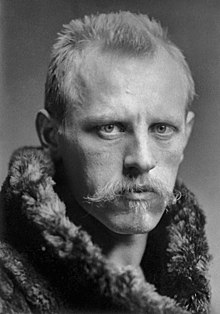
That's him!
Keep that in mind before you say you are not impressed! Thorough every hardship he went through, all the adversaries he faced; he did so sporting some epic 'stache!
Thursday, 9 October 2014
Brain Teaser of Birthdays!
One of my friends had a birthday yesterdau! To celebrate, I designed this brain-teaser; and now thanks to that person, ALL of your brains can be now be teased:
0, 8, 7, 15, 5, 13, 12, ??, 1, 9, 8, 16
Answer in the comments please.
By extension, if you don't know the answer, please don't look at the comments.
0, 8, 7, 15, 5, 13, 12, ??, 1, 9, 8, 16
Answer in the comments please.
By extension, if you don't know the answer, please don't look at the comments.
Monday, 6 October 2014
My game will go on!
It's tough for me making content for a game. I don't know what makes it so hard, but every time it's time to make a new level or add a new character or something, there is a part of me that says "meh".
Maybe somewhere deep inside dwells a finance-guy.
At any rate, when I do see the empty canvas in front of me it's a different story. Then my imagination starts roaring with all these new and crazy ideas, some of which may be both good and executable. The new level should be available shortly for your viewing pleasure. After that you might have to wait for a while before seeing a new screenshot.
We don't want to spoil you, do we?
Sunday, 5 October 2014
Regarding the previous update
It has occurred to me that updating to inform the readers of the frequency of updates might be considered a form of malpractice amongst bloggers. The fact I termed the update "More Updates" or something of the kind reveals a tenacity towards keeping this blog updated for the sake of updating it, even if I justified it by revealing a tiny bit of information about my game. It was very disingenious of me, and for that I apologize.
Consequently, in a moment of self-awareness, I will now inform you that I will not make an update wherein I discuss the implications of this update.
Have a happy day!
Consequently, in a moment of self-awareness, I will now inform you that I will not make an update wherein I discuss the implications of this update.
Have a happy day!
Subscribe to:
Posts (Atom)